Kindly Calm Me Down
When Everything Feels Urgent
Every day, the world feels like it is vibrating with urgency. Headlines move faster than our bodies and minds can process. A 24-hour news cycle informs us of endless global wars and crises, along with artificial intelligence threatening entire industries. Even the calmest of us are not immune. These alerts, updates, and predictions each ask for our attention, our reaction, and our fear. So many of us live in a state of chronic informational pressure. We may be intentionally trying to stay awake to suffering, informed about danger, and responsive to a world that may feel unstable, but your sense of peace may be the cost. The body does not always experience this as well-intentioned awareness, but can experience it as an alarm.
Our nervous systems evolved for immediate physical threats; we were never designed to process constant psychological distress. When the body stays in that state for too long, our ability to think from a clear state begins to erode. It is easy to believe that if we keep consuming enough information, we will eventually feel more prepared. Often, the opposite happens, and over time, that pressure alters the functioning of our brain. Emerging research on information and social media overload suggests that when the volume of input exceeds our ability to meaningfully process it, our cognitive and emotional resources are drained. Strain results rather than clarity, leading to fatigue, anxiety, and mental and emotional exhaustion rather than insight (Li et al., 2024).
The Paradox of Awareness
That creates a difficult paradox: staying informed matters, but the body does not always experience constant awareness as wisdom. When our nervous systems are always on edge, how can we make grounded, thoughtful decisions about work, life, relationships, and the world we help co-create?
Many of us may have moments of overwhelm, worrying about job security, what might happen if AI makes skills obsolete, or how society might be reshaped with widespread upheaval. What happens when you can’t predict what’s going to happen next with multiple global crises and their downstream repercussions? When the nervous system is naturally primed to react to these threats, it feels impossible to control our emotions and reactions. How do we stay informed without living in constant activation? If you somehow manage not to feel threatened or reactive to the noise, are you numbed out or dissociated from reality? Is being reactive the “right” response?
We need to figure out this balance of modern life. If we remain untouched, we risk indifference. If we remain constantly activated, we lose access to the capacities we need most: discernment, perspective, patience, and care.
Research on stress suggests that constant alarm drives reactive, defensive behavior such as narrowed attention and impulsive responses, making flexible thinking and thoughtful response harder, not easier (Arnsten, 2009; Arnsten, 2015). Conversely, a regulated physiological state supports clearer thought, steadier emotions, and considered actions. While it is important to be informed, living in a state of continual distress does not necessarily make us more compassionate, kinder, or thoughtful; it actually makes us more reactive and disconnected.
Information can expand our knowledge while simultaneously shrinking our nervous system’s sense of safety and weakening the capacities we need to respond well. How do we stay informed and care about what is happening in the world without letting our nervous systems live as if danger is constant and immediate?
When Stress Changes the Way We Think
Stress, especially when it feels unpredictable or out of our control, leads the brain to reorganize around survival. Activity shifts away from the prefrontal cortex, weakening the functioning involved in planning, reasoning, judgment, self-regulation, empathy, and flexible decision-making, while strengthening more defensive systems designed to detect threats and keep us safe (Arnsten, 2009; Arnsten, 2015).
Under non-stress conditions, the prefrontal cortex helps us hold complexity, consider consequences, regulate impulses, and respond with restraint. Under stress, those capacities become less available. We are thinking differently, not less: more impulsively, more protectively, more automatically, and often more rigidly (Arnsten, 2009; Arnsten, 2015).
That shift makes sense when danger is immediate, but less helpful when the threat is ambient and ongoing, such as economic uncertainty, political instability, moral distress, or a constant stream of alarming information. We may think our mind is working its way through complexity, but our bodies are responding as if they’re under siege. Stress alters not only how we feel, but also what kinds of thinking are available to us. Once you understand that, you can start asking different questions, not just “What should I do?” but “What state am I in while I’m deciding?”
The Cost of Too Much Information
We may assume that greater exposure to information leads us to be more responsible and better prepared. But exposure without regulation can become its own kind of impairment. We may know more facts while draining our cognitive and emotional resources, leaving us feeling less capable of deeper engagement and perspective. We may care deeply and still become strained, impatient, fragile, numb, and less effective. More information does not necessarily produce more wisdom; it fragments our attention and intensifies reactivity. The quality of our attention shapes the quality of our decisions.
Why Thinking Alone Isn’t Enough
Many of us respond by attempting to assert control and think our way out. If we strategize and have a plan, we’ll feel much safer. We can tell ourselves to calm down, stop overreacting, or think positively, but if stress alters our physiology, which shapes our cognition, then clarity cannot be restored by thought alone. We need to access a different state in the body to get ourselves back on the path of steadiness, not craft a better argument or a more sound plan.
The Intelligence of Internal Signals & How Safety Shapes Perception
Safety is both environmental and physiological. The body is constantly taking in, interpreting, and integrating signals from within, called interoception. Research suggests that these signals play an important role in emotional experience, self-awareness, mental health, sense of self, social relatedness, and even decision-making (Khalsa et al., 2018; Schmitt & Schoen, 2022).
We do not experience reality only through thought; our inner life is shaped by what the body signals and how those signals are interpreted. Our internal state directs our experiences of threat, connection, and regulation. Changes in breathing, heartbeat, tension, gut sensation, activation, or ease all help shape how the world feels to us and how we respond to it. When we can accurately notice those signals, we are often better able to understand what is happening inside us and feel more in control, rather than being unconsciously driven by them (Khalsa et al., 2018; Schmitt & Schoen, 2022).
Even within a world where external safety is unstable, self-regulatory practices help us access “internal safety”, the felt sense of assurance that allows our nervous systems to exit threat mode. This does not automatically eliminate distress or alleviate suffering, but may shape how we respond to external stressors. It can help us shift from being overwhelmed by our internal state to becoming more aware of it, more curious about it, and less attached to it.
It is possible to feel, move through life, and make grounded, clear, and connected decisions, even during chaos. You need to understand how to access your internal source of safety, not just by changing your surroundings.
Window of Tolerance
The window of tolerance describes the zone in which we can remain calm, alert, emotionally regulated, cognitively flexible, and connected with ourselves and others without becoming overwhelmed or shutting down. Outside the window, our nervous systems shift into states of hyperarousal (anxiety, anger, panic), or hypoarousal (numbness, shutdown, and dissociation); clear thought and relational presence become harder to maintain. So much of modern life pushes us outside this window, leaving us alternating between overwhelm and exhaustion.
Calm Is Not the Absence of Reality
Calm is often misunderstood. It can sound like passivity, denial, or withdrawal from what is real, but it doesn’t have to mean disengagement. It can actually signal the restoration of conditions where our minds can begin to reflect.
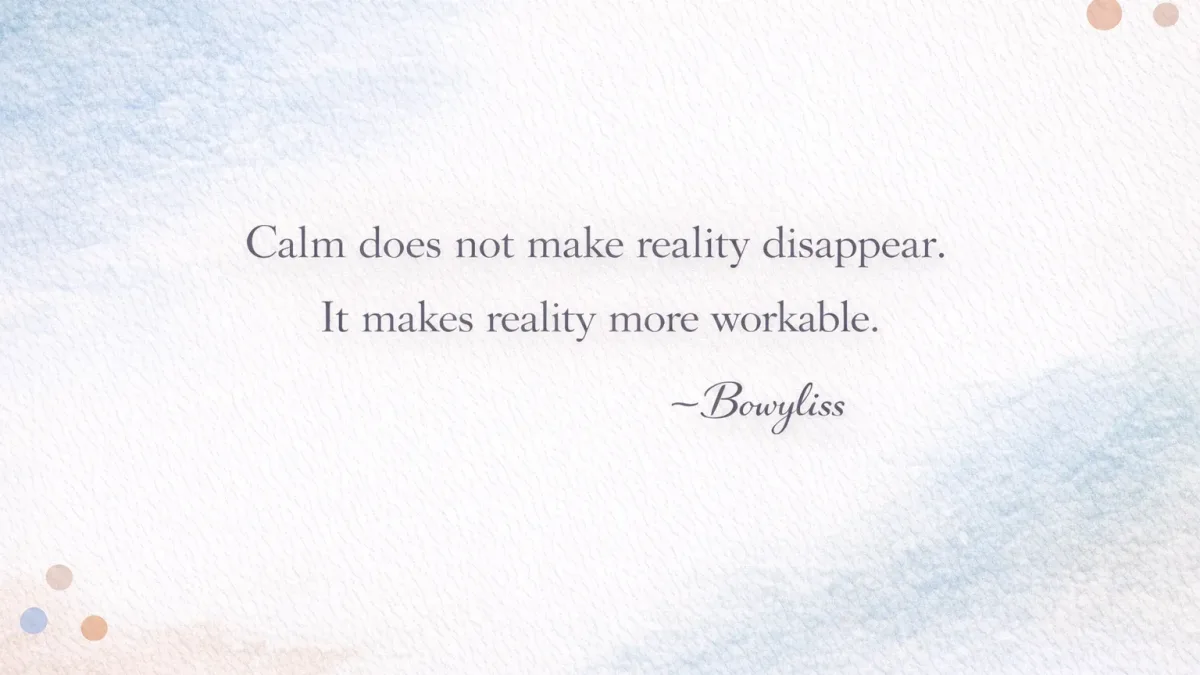
When our bodies move out of sustained threat activation, even slightly, our brain systems involved in attention, emotional steadiness, flexible thinking, and reflective choice can begin to recover (Shaffer & Ginsberg, 2017; Arnsten, 2015). A feeling of calm does not mean we are numb or dissociated from reality. It can mean we are regulated enough to stay present without being overtaken by fear. Regulated engagement makes reality more workable and is necessary for intentional decision-making.
While external safety can't always be assured, our bodies require some degree of internal safety to process information, contemplate, and react thoughtfully.
Regulation and Choice
Learning to tune into and soothe your bodily signals enables you to generate a sense of safety from within (Schmitt & Schoen, 2022; Khalsa et al., 2018; Porges, 2022). In an uncertain world, it is especially important to have a flexible nervous system that allows us to return to calm soon after stress. Breathwork and mind-body methods that combine gentle movement, grounding, awareness, body sensing, compassion towards the nervous system, or rest are practices and tools to remind your body that it is safe and may help shift its state to strengthen the calming response over time, lessen anxiety, and support more flexible emotional regulation (Zaccaro et al., 2018; Laborde et al., 2017; Luo et al., 2025; Shaffer & Ginsberg, 2017). These approaches, though not magical or universally curative, signal to our bodies to relax their guard, letting the mind regain the capacity to reflect rather than react. What would it mean to treat calm not as an escape from responsibility, but as the preparation for grounded, intentional, flexible, values-based decisions?
We Do Not Regulate Alone
We may have been taught that regulation is something that we are supposed to do alone, but humans are wired to regulate our nervous systems together. We synchronize and regulate each other constantly through facial expressions, eye contact, voice tone, touch, presence, and perceived closeness, reducing how threatening the world feels to the brain and body (Beckes & Coan, 2011; Coan et al., 2006; Coan et al., 2017).
Safety spreads through relationships; supportive connections appear to buffer stress, helping the brain and body interpret challenge as more manageable (Beckes & Coan, 2011; Coan et al., 2017). Simply being near a trusted and supportive presence reduces the brain’s need for threat vigilance and self-regulation effort (Beckes & Coan, 2011; Coan et al., 2006).
Safety can feel contagious; when we interact with someone whose nervous system is settled, our own body often begins to settle. A trusted voice, a familiar face, a hand on the shoulder, someone who remains steady in our presence, can cue the body and lessen the need for us to stay on guard. Focusing on one’s internal safety doesn't mean isolation; it allows for connection (Beckes & Coan, 2011; Coan et al., 2017).
Finding Safety Without Certainty
Sometimes the fastest way back to clarity is not changing the situation, but changing the state from which we are meeting it.
A hard truth in adult life is that safety and certainty are not the same thing. Many of us are waiting for the world to become less chaotic before allowing ourselves to settle, but the world may not offer that. Uncertainty will remain as the world around us changes rapidly, permeating headlines and conversations and demanding our attention. If you’re moving through life these days constantly on edge, do you notice it affecting your decision-making?
Instead of asking how we eliminate uncertainty from the world, we should ask how we cultivate enough safety within ourselves to meet that uncertainty. The nervous system does not need the world to be perfect to discover moments of safety. What is one practice, each day, that you can implement so that the next decision you make is grounded? Can you get your body to experience moments of calmness without requiring perfect external conditions? What decision might become clearer when your body feels safe enough to choose it? What would it look like if we all started making decisions from a grounded, regulated place instead of being guided by fear?
Decisions with Intention
A more regulated physiological state appears to support clearer thinking, emotional balance, stronger self-regulation, and more reflective choices (Arnsten, 2015; Shaffer & Ginsberg, 2017). Calming your nervous system doesn’t guarantee wisdom, nor does it solve injustice, grief, uncertainty, or fear. Distress likewise doesn’t make it impossible for you to make wise decisions, but when our bodies are less burdened by threat, they open us up to reflection and workable emotions.
Practices such as embodied awareness, slow breathing, grounding, gentle movement, and present connection do not solve everything, but they can help create conditions in which thoughtfulness, presence, and care are more available to us (Arnsten, 2015; Zaccaro et al., 2018; Coan et al., 2017). What if the next important decision you made came not from fear, urgency, or internal pressure, but from a body that felt safe enough to express?
Kindly, Calm Me Down
The state from which we make our decisions is shaping the decisions we make. The steadier our system, the less likely we are to mistake urgency for truth or reactivity for conviction. Sometimes the wisest thing we can do is become less physiologically available to panic, so we can meet reality without being consumed by it.
What would businesses look like if we made aligned mission-based decisions, or our lives if we made aligned values-based decisions? Let’s make our choices from a place of calm and peace so that our world is shaped by this rather than directed by fear.
Challenge yourself to find a way to keep informed and remain steady enough to care without surrendering to alarm. This is not permission to become numb or naive, but to feel without becoming unusable. The state from which we make choices is directing the choices we make. How are you going to work on your state?
(Thank you, Meghan Trainor, for the inspiration!)
Arnsten, A. Stress signalling pathways that impair prefrontal cortex structure and function. Nat Rev Neurosci 10, 410–422 (2009). https://doi.org/10.1038/nrn2648
Arnsten, A. Stress weakens prefrontal networks: molecular insults to higher cognition. Nat Neurosci18, 1376–1385 (2015). https://doi.org/10.1038/nn.4087
Beckes, L. and Coan, J.A. (2011), Social Baseline Theory: The Role of Social Proximity in Emotion and Economy of Action. Social and Personality Psychology Compass, 5: 976-988.https://doi.org/10.1111/j.1751-9004.2011.00400.x
Coan, J.A., Beckes, L., Gonzalez, M.Z., Maresh, E.L., Brown, C.L., Hasselmo, K. Relationship status and perceived support in the social regulation of neural responses to threat, Social Cognitive and Affective Neuroscience, Volume 12, Issue 10, October 2017, Pages 1574–1583,https://doi.org/10.1093/scan/nsx091
Coan, J. A., Schaefer, H. S., & Davidson, R. J. (2006). Lending a Hand: Social Regulation of the Neural Response to Threat: Social Regulation of the Neural Response to Threat. Psychological Science, 17(12), 1032-1039.
Khalsa, S. S., Adolphs, R., Cameron, O. G., et al. (2018). Interoception and Mental Health: A Roadmap. Biological Psychiatry: Cognitive Neuroscience and Neuroimaging, Volume 3, Issue 6, 2018, Pages 501-513.https://doi.org/10.1016/j.bpsc.2017.12.004
Laborde S, Mosley E, and Thayer JF (2017) Heart Rate Variability and Cardiac Vagal Tone in Psychophysiological Research – Recommendations for Experiment Planning, Data Analysis, and Data Reporting. Front. Psychol. 8:213. doi: 10.3389/fpsyg.2017.00213
Li, K., Jiang, S., Yan, X., & Li, J. (2024). Mechanism study of social media overload on health self-efficacy and anxiety. Heliyon, 10(1), e23326.https://doi.org/10.1016/j.heliyon.2023.e23326
Luo, Q., Li, X., Zhao, J. et al. The effect of slow breathing in regulating anxiety. Sci Rep15, 8417 (2025). https://doi.org/10.1038/s41598-025-92017-5
Porges, S.W. (2022). Polyvagal Theory: A Science of Safety. Front. Integr. Neurosci. 16:871227. https://doi.org/10.3389/fnint.2022.871227
Schmitt CM and Schoen S (2022) Interoception: A Multi-Sensory Foundation of Participation in Daily Life. Front. Neurosci. 16:875200. https://doi.org/10.3389/fnins.2022.875200
Shaffer, F. and Ginsberg, J.P. (2017). An Overview of Heart Rate Variability Metrics and Norms. Front. Public Health 5:258. https://doi.org/10.3389/fpubh.2017.00258
Zaccaro A, Piarulli A, Laurino M, Garbella E, Menicucci D, Neri B, and Gemignani A (2018). How Breath-Control Can Change Your Life: A Systematic Review on Psycho-Physiological Correlates of Slow Breathing. Front. Hum. Neurosci. 12:353. https://doi.org/10.3389/fnhum.2018.00353
Resources & Affiliate Links
I love @ToBeMagnetic. I've been a Pathway member with them for 2 years, and have been recommending them to anyone who's open to give meditation a try. Here's my referral code so you can get 15% off a membership and I'll receive a commission! *I'm not on the TBM team, just a passionate member
Code: SHAUNA
Disclaimer
This blog explores the intersection of science and spirituality across our LIVES pillars — Love, Intuition, Values, Energy, and Surrender. We'd love to hear your thoughts at hello@bowyliss.com!
Disclaimer - This blog is intended for educational and informational purposes only and does not provide mental health or spiritual advice. If you have questions about your specific situation, please consult a professional licensed to practice in your state.